Rampart Probe May Put Gang Injunction at Risk
LAPD Officer's Testimony Called Fabricated
By RICH CONNELL, ROBERT J. LOPEZ, Times Staff
Writers
September 19, 1999 Los Angeles Times
Fax: 2132374712
Some of the most persuasive police testimony used by
prosecutors to obtain a sweeping anti-gang injunction in Los Angeles was made up, according to
a fired Rampart Division (More about Rampart Division) officer who is
cooperating with investigators.
Former Officer Rafael A. Perez, testifying in secret to obtain a lesser sentence for stealing
cocaine from the Los Angeles Police Department's property room, has labeled as fabricated a
chilling portrayal of out-of-control gang violence served up by police and prosecutors to justify an
unprecedented legal crackdown on the 18th Street gang.
In a sworn court declaration, Officer Nino Durden, who was
Perez's partner, described the two officers being confronted by an assault weapon-wielding 18th
Street member who burst through a closed door in a vacant Pico-Union apartment building.
"He failed to comply with my commands and pointed the guns
toward my partner and I in a threatening manner," Durden's declaration said. "An officer-involved
shooting occurred . . . and the [gang member] is now serving [23 years] for an attempted
homicide on a police officer."
The officer's dramatic statement was used by the Los Angeles
County district attorney and the city attorney to help win one of the most sweeping anti-gang
injunctions ever handed down in a Los Angeles court against dozens of 18th Street members in
the Rampart Division. Now that the truth of the declaration has been questioned, the future use of
the injunctions could be in jeopardy.
As part of the largest unfolding LAPD corruption investigation
in 60 years, Perez has already told department investigators that the gang member referred to in
Durden's declaration was unarmed and handcuffed when he was shot. The officers then framed
the victim with a planted rifle, Perez told investigators. Perez made the admission as part of a plea
bargain in his cocaine-stealing case. Durden could not be reached for comment.
The gang member, Javier Francisco Ovando, was freed from
state prison Thursday at the request of prosecutors. He has been confined to a wheelchair since
the shooting.
A dozen LAPD officers have been relieved of duty or forced to
leave the department in the expanding investigation. Perez has been fired and Durden has been
placed on leave. The investigation was begun internally by the LAPD and has been joined by
federal authorities looking into possible civil rights violations by Rampart officers against suspects
who were shot, beaten or allegedly shaken down.
Another man, Jose Perez, has told The Times that Rampart
officers in July 1996 killed his friend and shot him in the back, then tried to frame him. Former
Officer Perez has told LAPD investigators that the shooting was "dirty."
The shootings and other allegations are focusing intense scrutiny
on the Rampart Division gang suppression unit known as CRASH, a citywide program whose
acronym stands for Community Resources Against Street Hoodlums.
"I think this has blown the top off an ongoing pattern of
misconduct that has been occurring for a long, long time," said Dennis W. Chang, an attorney for
Ovando family members.
The consequences of the spreading police inquiry already have
partially undermined two court injunctions against 18th Street gang members.
Spokespersons for Dist. Atty. Gil Garcetti and City Atty. James
K. Hahn said Friday that they were reviewing the sworn statements provided by Durden, Perez
and other Rampart officers. As a result, Garcetti's office said enforcement of the injunctions,
which restrict gang members' activities, have been suspended in the case of several 18th Streeters.
Both prosecutorial offices said they were seeking a postponement of a hearing on one of the
injunctions set for this week.
The elite, hard-charging Rampart CRASH squad had a
reputation for heavy-handed tactics among some residents of the neighborhoods west of
downtown. Its officers roamed the busy streets and dark alleys in unmarked Chevrolets, the first
line of defense against about 30 street gangs battling block by block for turf and lucrative drug
profits.
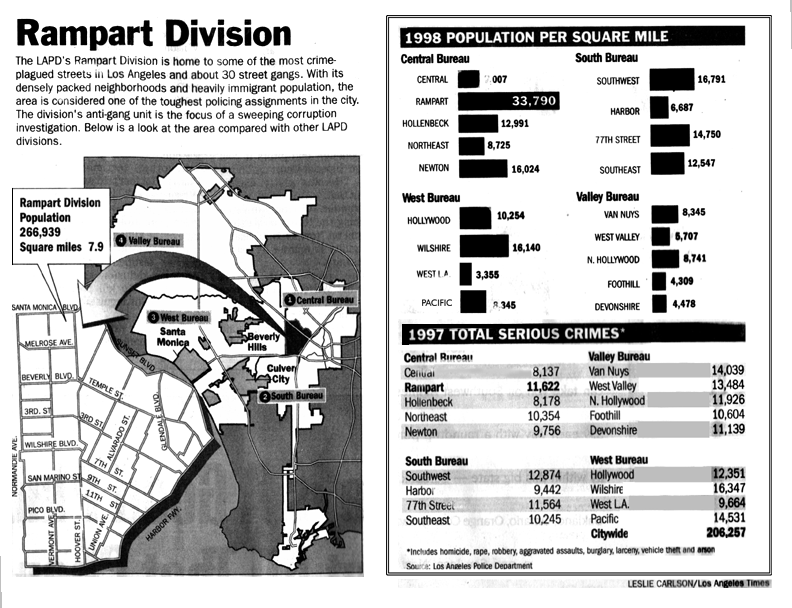
The 8-square-mile Rampart Division is home to the densest
population west of the Mississippi. It has one of Southern California's heaviest concentrations of
transient and disaffected immigrants, and of working-poor families.
And it is there, where police deal daily with some of the most
grueling workloads in Los Angeles, that Durden, Perez and at least 10 other officers are under
scrutiny in a wide-ranging probe of possible illegal shootings, shakedowns of drug dealers and
cover-ups.
How Much Did Supervisors Know?
Durden's willingness, under penalty of perjury, to offer up an
allegedly fabricated tale of the 1996 Ovando shooting underscores some of the investigators'
central concerns.
Inside the tightknit world of one of the city's proudest and
busiest anti-gang units, had officers succumbed to--or purposely overlooked--a culture of lying
and misconduct?
Was this reflective of one or two rogue officers or a larger
group that had spun out of control, taking the law into its own hands and mirroring the actions of
the gangs the officers were assigned to control?
And perhaps more important, where were their supervisors?
"You've asked the $64,000 question," said Cmdr. James
McMurray, head of the LAPD's Internal Affairs Group. "I think we're gonna find out."
CRASH officers, particularly in the Rampart Division, operate
in an intense environment. This was especially true during the late 1980s and early 1990s, when
gang violence surged to record highs.
Emboldened gangs, in some cases working closely with the
prison-based Mexican Mafia, had expanded into drug sales, racketeering, street extortion and
contract murders.
In 1992, when homicides in Los Angeles hit their peak, Rampart
was the most violent of the LAPD's 18 divisions.
Among other things, the division's CRASH officers had to
contend with the violent core of two mega-gangs--Mara Salvatrucha and 18th Street--which
regularly topped the city's list of involvement in murders, robberies and witness intimidation.
CRASH responded with forceful tactics of its own. The unit's
officers often rolled out after dark, zipping back and forth across the neighborhoods around
MacArthur Park. They rousted suspected gang members on street corners, lining them up with
their hands behind their heads, patting them down and interrogating them about alleged gang
activity.
"You go in there and rock 'n' roll," said one LAPD veteran who
worked CRASH operations in Rampart. "It's a group think. It's a kick-ass think."
That gung-ho attitude fostered a climate ripe for abuses, the
officer said.
Mix of Ill Will and Gratitude
"They figure these guys are gang members, they're here illegal.
If [the gangbangers] didn't do something, they'd plant something on them.
"It keeps 'dummy' off the street, keeps [arrest] numbers up, and
everyone's happy. You would hear a spattering of that. It's very hush-hush."
Some LAPD sources complain that CRASH officers are often
the targets of fabrications themselves. Gang members try to pile misconduct complaints on
officers, hoping to get them transferred out of the neighborhood, the sources say.
"I've seen evidence of that," said McMurray, the Internal Affairs
commander.
The Rampart CRASH unit's aggressiveness has engendered a
mix of ill will and gratitude among residents. Many are less concerned about gang members' civil
rights being violated than about the elimination of what they view as a constant threat to their
families and businesses.
But the images of officers routinely pulling over young Latinos
has left many residents leery. Such suppression tactics, they say, can sweep up innocent youths.
Max Ocon, a longtime Rampart area businessman and member
of the division's community policing advisory board, said relations between police and residents
hit a low in the mid-1990s--the period under scrutiny by investigators.
In 1996, he said, "there were many abuses by the police. . . .
They treated the people like animals."
Residents found themselves coping with a "double-edged
sword--on one side there were gangs, and the other side the police," said Ocon, adding that
relations with the police have improved significantly since then.
Complaints About CRASH Tactics
He and others question whether the allegations of egregious
conduct being investigated would have occurred--or gone unnoticed for as long a period--in more
affluent areas of the city, such as parts of the Westside or San Fernando Valley.
Many members of Rampart's large Latino immigrant population
hesitate to speak up against the gangs or the police out of fear of retribution or deportation.
Police have claimed that the gangs have monitored 911 dispatches to determine who is
cooperating with authorities.
Many of the residents have also come from countries where
police corruption and human rights violations are more the norm than the exception.
"Our community is one that does not complain because of fear .
. . fear of immigration [officials] or the gangs," Ocon said.
But some people did complain.
Officials at Police Watch, a nonprofit organization in Los
Angeles that monitors police abuse and collects complaints, say they received many misconduct
complaints involving Rampart Division officers during the period under investigation by
authorities.
LAPD records do not show an inordinate number of complaints
at Rampart.
In August 1994, according to Police Watch, a 28-year-old
Latino said he was beaten and wrongfully arrested by Officer Perez. The man told the group he
was sitting in his car when Perez and another officer pulled up about 9:30 at night. After he was
ordered out of his car, the man said, he asked Perez what was going on. This sparked an angry
response, according to the man's statement to Police Watch.
"Perez grabbed [the man] by the arm [and] punched him in the
mouth," the statement says. He was then "thrown to the ground [and] cuffed. One officer then put
his foot on subject's head."
New Captain to Deal With Fallout
The man said he suffered bruises, strained muscles and a swollen
left knee. He was arrested for hitting Perez, according to the complaint.
Perez's lawyer, Winston McKesson, said he was not aware of
any lawsuits or disciplinary actions against his client. Given Perez's admission of wrongdoing as
part of a cooperation deal with investigators, McKesson said, "What you're going to find is people
coming out of the woodwork" with complaints about Perez's behavior.
Another complaint was filed by the mother of a gang member.
She alleged that CRASH officers ransacked her home in November 1995 when they executed a
search warrant in pursuit of her son.
"Officers went through the house pulling everything out," she
said in her Police Watch statement.
Her son was not home, but surrendered the next day. Two days
after that, she said, he came home with his face "swollen and bruised."
The mother asked her son what happened. He told her to "leave
it alone, because he had to stay there [in the area]," according to the statement.
Rampart CRASH officers saw themselves as working against
deep-rooted, menacing forces. Their views were captured in a series of sworn declarations filed in
support of the two court injunctions against 18th Street gang members. Among those were
statements by Perez, Durden and other officers under investigation.
One of the suspended officers provided a lengthy overview of
the gang's assaults, shootings and threats. "These crimes are committed against rival gang
members, innocent civilians and even police officers," the declaration stated.
Perez, who called himself a "narcotics expert" with more than
600 drug arrests under his belt, described citizen pleas for help and some of his efforts to control
ongoing drug sales.
As the investigation into Rampart corruption proceeds, many
questions will focus on who may have known about the alleged wrongdoing and supervision
failures within the police station.
There have been persistent concerns about the quality of
supervision of CRASH details in general, according to some current and former LAPD officials.
"Ever since I have been involved in the process, there has been
more of a concern about CRASH units because the level of direct supervision always appeared to
be less [than] in some of the other LAPD units," said former LAPD Inspector General Katherine
Mader.
The new Rampart captain brought in to deal with the
repercussions of the corruption probe said he expects the LAPD to emphasize more frequent
rotation of officers through intense units such as CRASH.
"I have to deal with what's happening right now," said Capt.
Bob Hansohn.
"I don't know what the environment was back in 1996. But to
my officers the message always sent out is: 'The end never justifies the means.' "
* * *
Rampart Division
The LAPD's Rampart Division is home to some of the most
crime-plagued streets in Los Angeles and about 30 street gangs. With its densely packed
neighborhoods and heavily immigrant population, the area is considered one of the toughest
policing assignments in the city. The division's anti-gang unit is the focus of a sweeping corruption
investigation. Below is a look at the area compared with other LAPD divisions.
Copyright 1999 Los Angeles Times. All Rights Reserved

Comments to jnr@insightweb.com
|